

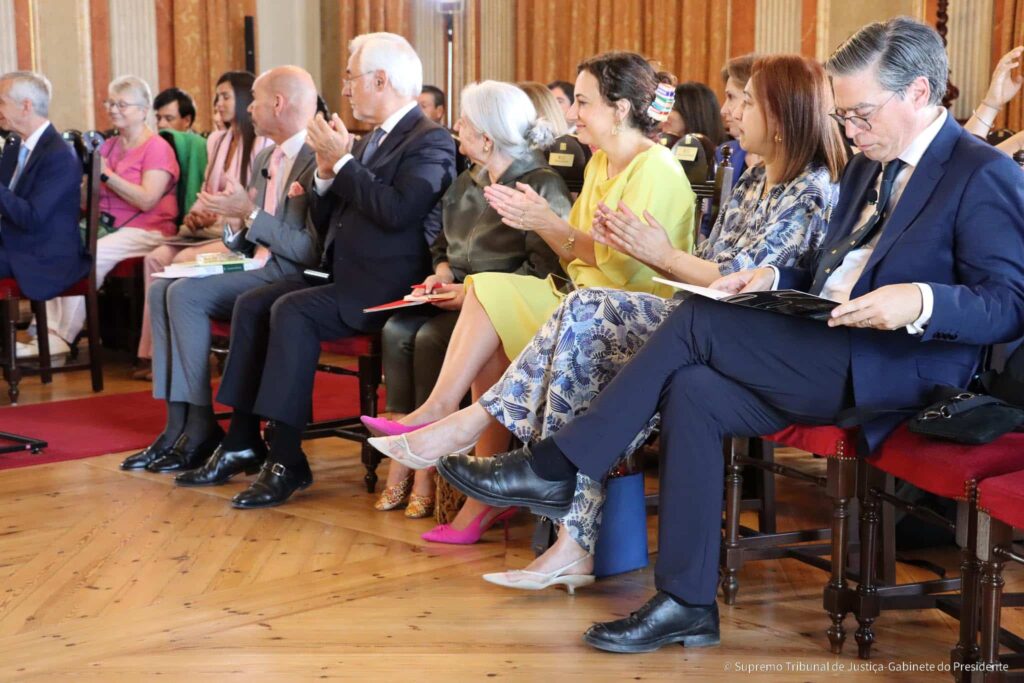
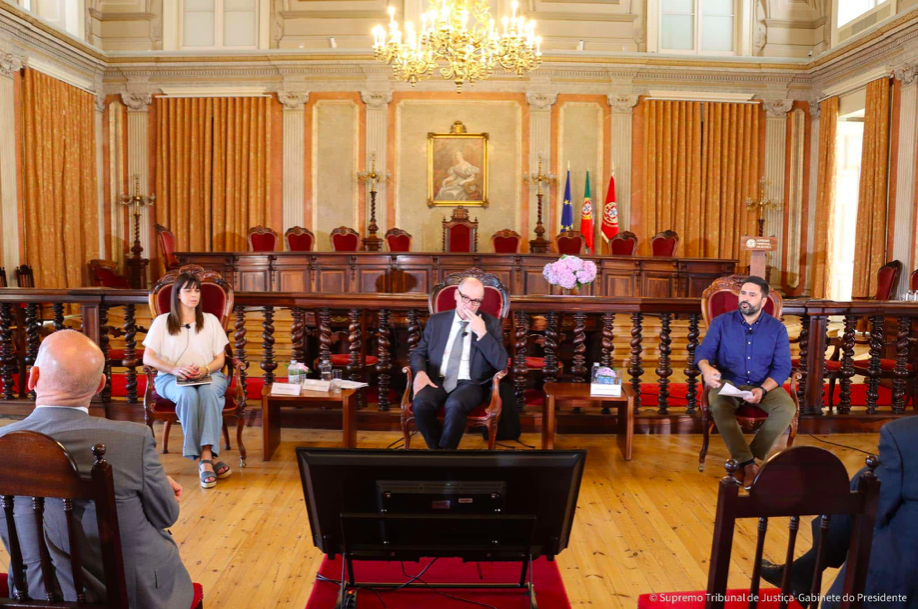
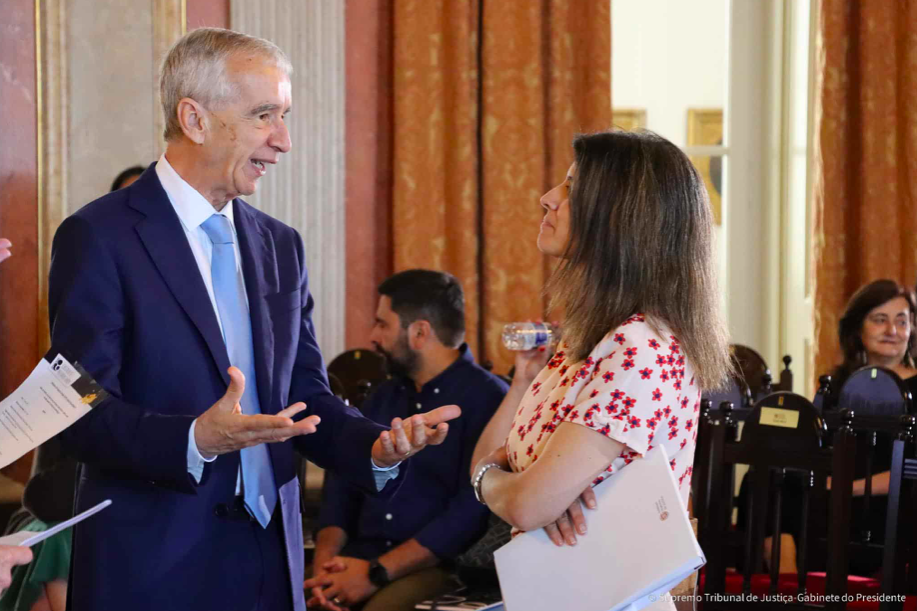
On June 27, 2025, COPE held its fourth Judicial Roundtable, hosted by the Portuguese Supreme Court of Justice in Lisbon.
A central goal of the event was to explore children’s right to participate in a parent’s criminal court proceedings — to ensure their voices are heard and meaningfully considered in safe, child-friendly ways. The key stages at which children’s rights are often overlooked by judges include: when authorising or supervising a parent’s arrest; at first presentation of suspect to judge; when deciding on pre-trial measures; during trial; and sentencing and post- sentencing/supervision of sentence. Consideration of children and their rights remains starkly different among criminal courts and family courts, where there tends to be more protective measures in place and greater awareness of children’s rights.
Speakers included the Supreme Court President, two Supreme Court Justices, alongside other prominent speakers of the Portuguese judiciary, underscoring a commitment within the country to protecting children’s rights in criminal proceedings. Since 2022, COPE has intensified its judicial work, promoting respect for children’s rights throughout all stages of a parent’s or primary caregiver’s criminal court proceedings. This has involved a series of European Judicial Roundtables convening key actors from across the continent, examining system gaps and exploring solutions to better protect children affected by parental imprisonment.
The event on June 27 brought together 41 participants, including family and criminal court judges from various levels (first instance, appellate and Supreme Court), prosecutors, lawyers, academics, civil society actors and representatives from the Portuguese prison service.
Hearing children during a parent’s criminal court proceedings: how and why?
Judge Paulo Guerra of the Court of Appeal Coimbra affirmed that hearing children during a parent’s criminal court proceedings is a legal duty under the UN Convention on the Rights of the Child, ratified by Portugal in 1990, and applicable under its Constitution. However, he noted that children’s right to be heard during parental responsibility proceedings in Portugal lacks explicit constitutional recognition and called for clear enshrinement of this right, alongside stronger implementation in judicial practice. Judge Guerra proposed that court judgments concerning children should consistently document key child-related details — including the child’s age, whether they were heard and reasons if not, the date of the hearing and the assessment of the child’s discernment — to strengthen accountability, transparency and consistency in applying children’s rights.
Outlining best practices, he stressed that child hearings should take place in calm, child-friendly settings and be led by trained professionals who use clear, empathetic communication. Because of their complexity, such hearings often require the involvement of qualified psychologists or child psychiatrists, with judges focusing on guiding the factual inquiry rather than asking direct questions.
“If the best interests of the child are to be fully respected, then their active participation in decisions which concern them is the one of the best ways of realising that principle.”
— Judge Paulo Guerra
Listening to children — change led by experience
Mireille Farrugia, a Maltese lawyer, drew on her lived experience of attending her father’s trial and imprisonment as a teenager to underline the vital distinction between a child’s presence in court and their active participation. She stressed that at each stage — from verdict to sentencing and appeals — children’s perspectives and the emotional burden they face is often overlooked. She stressed the need for children to be heard in safe, supportive environments outside the courtroom and highlighted the enduring social, emotional and financial impacts such experiences can have. She emphasised that a child’s views must be actively sought and genuinely considered in all cases which have an impact on them.
A civil society perspective: the importance of judicial training
Carla Mendes and Gonçalo Martins from CASPAE, Portuguese NGO and COPE member, stressed the need for judicial training on the realities faced by children with imprisoned parents. Through their project “Agents of Transformation – 3Cs Program,” they have developed interdisciplinary training modules for judges, prosecutors and other professionals, covering case law, child impact, best practices and inter-institutional collaboration, all aligned with Portuguese and EU legal standards. They also presented their implementation of the Game with Mum & Dad project in Coimbra — a prison-based and COPE-led initiative that strengthens the child–parent bond through sport — recently launched in Portugal with corfebol matches involving nine fathers and 17 children, creating a safe, stigma-free space for connection.
Child-friendly justice in the context of parental imprisonment: children residing in prison with their primary caregiver
Justice Carlos Campos Lobo, a Portuguese Supreme Court Justice and former Deputy Director-General of Portugal’s Directorate-General for Reintegration and Prison Services (DGRSP), discussed the rights and realities of children living in prison with their primary caregivers. Since 2009, Portuguese law allows children to reside in prison with a parent until age three (or up to five in exceptional cases), but only mothers have made such requests, largely due to a lack of childcare facilities in male prisons. Currently, two prisons in Portugal have childcare facilities. More broadly, the DGRSP is working on initiatives to improve child-parent connections, including enabling family visits that allow imprisoned parents to see partners and children together, and creating offsite visit spaces for fathers at court premises.
European standards
Justice João M. da Silva Miguel, a Portuguese Supreme Court Justice, reviewed key European Court of Human Rights (ECtHR) rulings on the right of contact between imprisoned parents and their children, emphasising that while imprisonment restricts family life, prison authorities have a duty to facilitate meaningful contact under Article 8 of the European Convention on Human Rights. He highlighted the Court’s approach of balancing realities and requirements of prison settings with children’s family rights, requiring states to provide child-friendly visiting environments and avoid disproportionate restrictions. He cited cases like Subaşı and Others v. Turkey, which stressed the importance of flexible visits that respect children’s schooling. David Mackie, retired Sheriff (Judge) from Scotland, highlighted the Council of Europe’s standards, aligned with the UNCRC, advocating accessible, age-appropriate justice systems for children with imprisoned parents. He illustrated Scotland’s Children’s Hearings System (CHS) as a rights-based model focused on child welfare and participation. Two case studies highlighted practical judicial steps: requesting child impact assessments to understand sentencing effects on children and postponing sentences to allow parents to arrange childcare.
Following the event and upon invitation by the European Training Platform (ETP) — an EU-led search platform for justice professionals who want to train themselves in any practice area of EU law or related matters — COPE is listed as an official training provider on the platform. See COPE’s online page here, where further resources and training proposals related to this topic will be disseminated.
Looking forward, COPE wishes to build on the momentum of this event — both within the Portuguese national context and further afield. COPE is exploring the possibility of hosting its a 2026 roundtable. Insights and ideas from this event will be carried forth — notably surrounding how children’s voices should be heard during a parent’s legal and judicial court proceedings.
Full event report is forthcoming and will be available here.
Read more about the previous COPE Judicial Roundtables here: