

An estimated 2.1 million children across Europe have a parent in prison on any given day.
Yet we often hear that considering the rights and needs of these children is a “niche” topic within criminal justice discussions, an “extra” issue, peripheral to the main objectives and realities of the prison world.
This was not the case at the Council of Europe’s 30th Conference of Directors of Prison and Probation Services (CDPPS) on 24-25 September. The event spotlighted children affected by a parent’s imprisonment, thanks to the leadership of the Committee for Penological Cooperation (PC-CP) and its Chair, Laura Negredo, Her closing remarks stressed that meeting the needs of children should not be an “add-on” consideration but one that lies within the remit of prison and probation services.

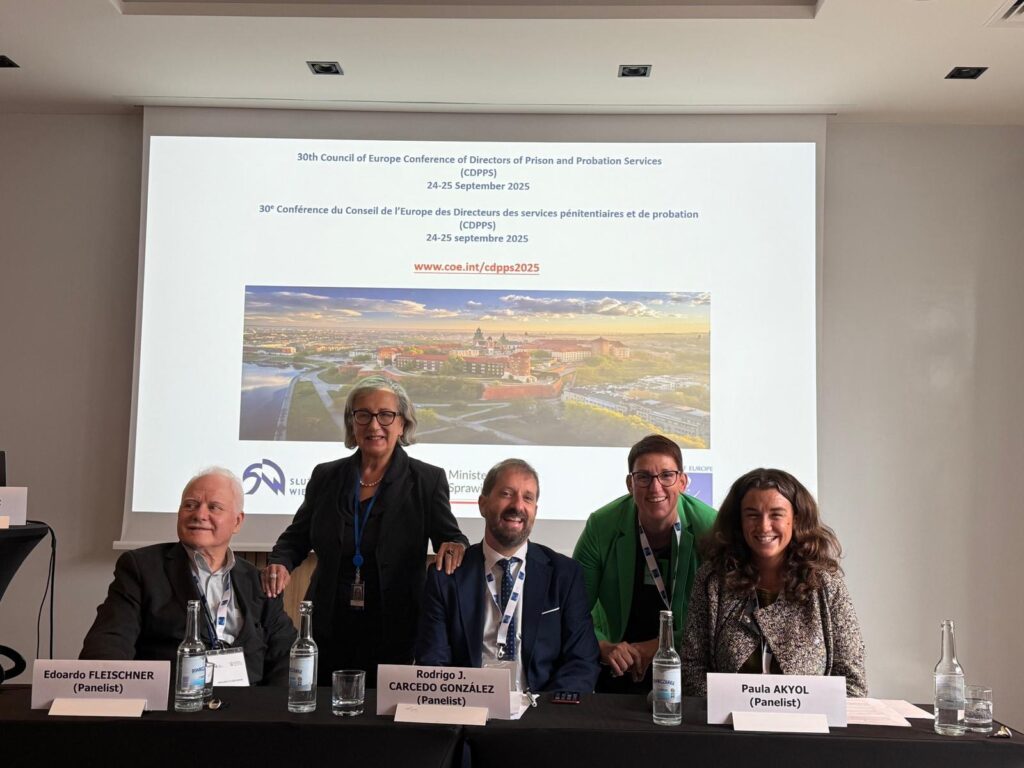
During a workshop at the event, Paula Akyol of COPE, alongside members Edoardo Fleischner of Bambinisenzasbarre and Dr Rodrigo Carcedo González of Salamanca University, highlighted exactly what children’s needs are. They showcased practical, child-focused approaches from across the COPE network, including:
- Child-parent visits in child-friendly NGO spaces outside prison, reducing stigma and stress
- School teachers entering prisons to keep parents involved in their children’s education
- Research on children’s experiences at different stages of parental imprisonment, informing in this way evidence-based support
- Training models for prison staff on child-sensitive practice
- Cross-sectoral meetings of stakeholders to spark national, system-level solutions
The work of COPE and the network is underpinned by Council of Europe Recommendation of the Committee of Ministers concerning children with imprisoned parents (CM/Rec(2018)5). The seed for this Recommendation was planted at the 2015 CDPPS. Ten years on, CM/Rec(2018)5’s impact across Europe is unequivocal.
Today’s message is clear: designing supports for these children should be done from a child-rights perspective, and this child-rights approach is compatible with criminal justice goals. People in prison or on probation need individualised support to sustain healthy relationships with the outside world, including family connections. Ongoing quality contact between children and their parent in prison can have positive effects on the parent’s social reintegration.
This message was echoed when a UN OHCHR study on the social reintegration of persons leaving detention and non-custodial measures presented to the Human Rights Council in September recognised that “interventions that support constructive family involvement contribute to effective reintegration”, with a child-rights based approach being essential.
Good practice exists, as seen above, yet much more remains to be done. Discussions during the event highlighted the difficult context and challenges which prison and probation services currently face: overcrowding, ageing populations in prison, difficulties recruiting and retaining staff, rising mistrust among the judiciary of non-custodial measures and increased political pressures which can prioritise short-term security narratives over long-term rehabilitative approaches.
COPE’s heartfelt thanks go to the PC-CP for keeping children on policy agendas at this high-level event, and for their support in guiding Member States to champion children’s dignity, irrespective of circumstances.
You can learn more about this event here.