

Athens, 07.07.2025
On 24 June 2025, COPE held the online seminar “Creative Connections,” organised in collaboration with the Special Health Center for Prisoners of Korydallos, the NGO EPANODOS for the support of released prisoners and the General Secretariat for Crime Prevention Policy.
Coordinators Liz Ayre, Arete Tsoukalas, Dimitra Theodorakopoulou and Christine Maerkl exchanged good practices with the participants with the aim of raising awareness about the needs of children with a parent in prison.
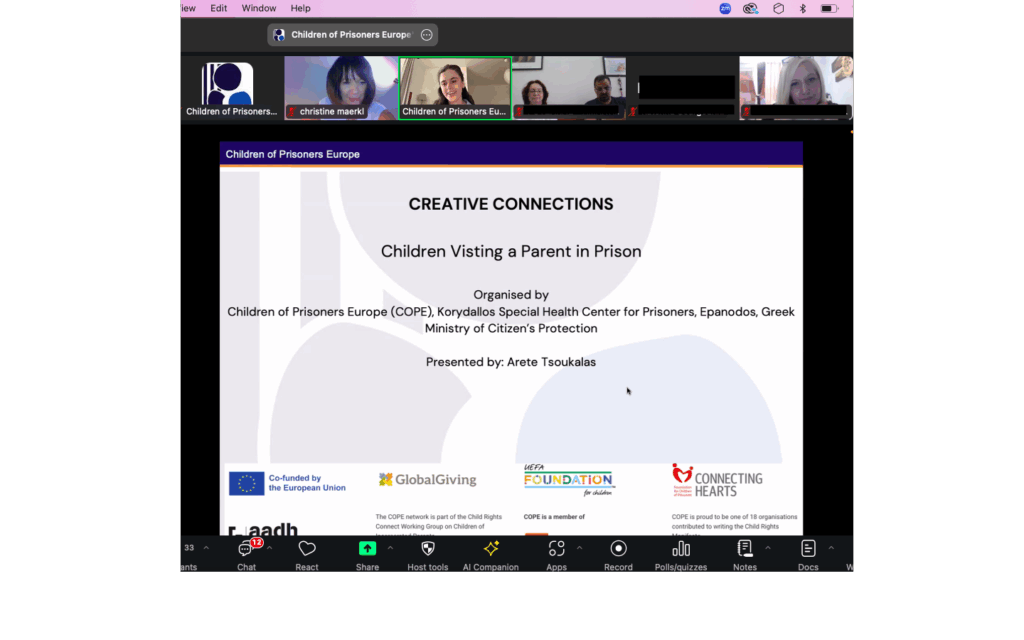
The Children of Prisoners Europe (COPE) network, a European network funded by the EU, works across sectors, collaborating with the police, judicial authorities, prisons, schools, health and child protection services, as well as with children and young people themselves, with the aim that systems adapt to the needs of children rather than the other way around.
In Europe, more than 2.1 million children experience separation from a parent due to imprisonment, with 800,000 of them living in EU countries. These children face unique challenges such as stigma, isolation and uncertainty, while maintaining their relationship with their parent is a critical factor for their mental and emotional development.
Visits should be designed with the child’s best interests in mind, be regular and meaningful, while open communication, participation in decision-making, support from a trusted adult, and contact with the parent in prison are recognized as fundamental needs of children. Special emphasis was placed on the importance of communication and maintaining the parent-child bond, as well as on the need for children to know that separation due to imprisonment does not mean abandonment and that they remain the subjects of their parent’s love.
As a French psychoanalyst noted: “Words humanise the experience; what is traumatic for a child’s future is what remains unspoken.”
During the meeting, a video of a children’s visit showing the children’s own experiences in prison was screened, followed by presentations of good practices from abroad and Greece, including:
- Children’s visits in Greek prisons
- Open prisons with family homes in Finland
- “Visitor Centers” in prisons in Scotland, Ireland, England, and Wales for family information and support
- “Spazio Giallo” play areas in Italy to reduce visit-related anxiety
- The possibility of online communication with a parent in Romania
- Family houses supported by social workers in Denmark
- Programs to strengthen family bonds and parenting in Wales
- Story recordings by prisoners for their children in Croatia, and football matches organized in many prisons across Europe
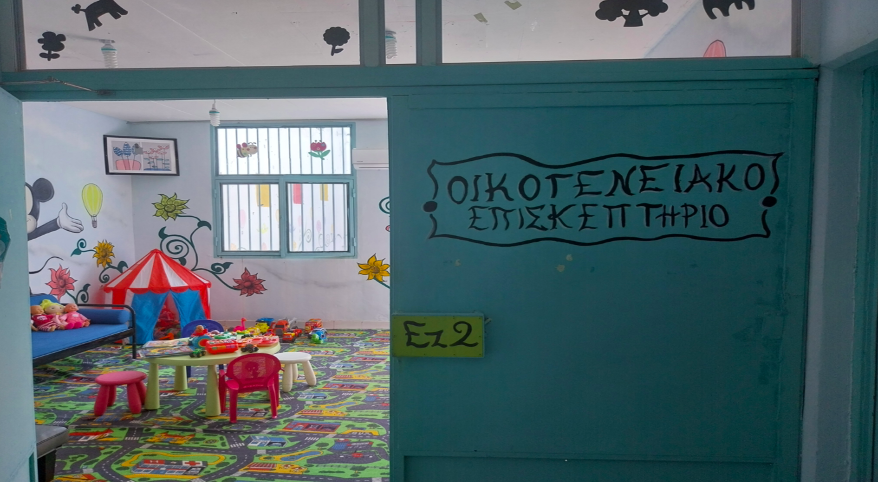
Particular mention was made of the importance of a child-centered approach to visits, with the creation of child-friendly spaces (including outstanding examples from Greece), and the accompaniment of children by specially trained volunteers or professionals who provide a sense of safety and continuity.
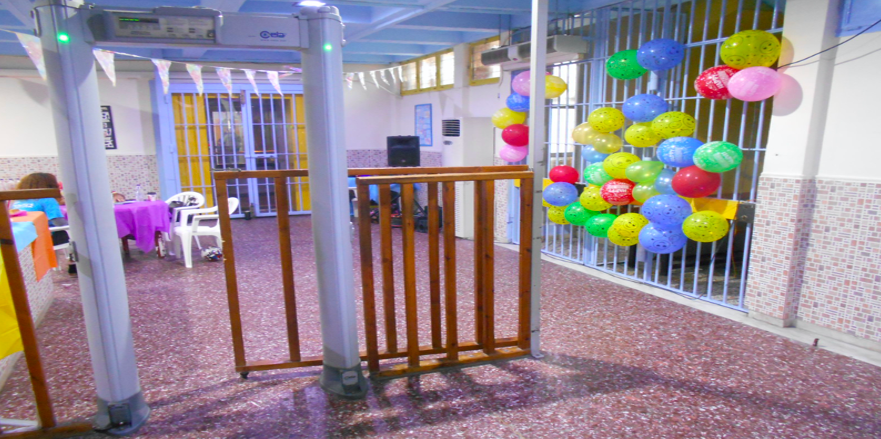
Security checks must be conducted with respect for the dignity of children, avoiding scenes that might traumatize them, such as the use of handcuffs in their presence.
From the side of the NGO EPANODOS, the immediate link was emphasized between strengthening and empowering family relationships and parenting and the better social reintegration of released prisoners, followed by the reduction of recidivism. Highlighting the need to support the family from the very beginning of the prison sentence, EPANODOS referred to the design of a pilot Family Office in cooperation with the Research Center for Equality Issues and the General Secretariat for Equality and Human Rights at the Eleonas Prison in Thebes, aiming for holistic support of the families of incarcerated mothers.
The seminar highlighted the need for cross-sector cooperation and the possible integration of other European good practices into the Greek context, to ensure that children with a parent in prison do not experience abandonment but maintain a strong and emotional bond with their family.
Follow-up initiatives organised by COPE are being planned for autumn 2025 in Greece.