

Stigma dismantled, dignity upheld — child rights standards for children affected by parental imprisonment
“Even when I say I’m a lawyer now, people find that surprising. People say ‘oh my God, your father is a criminal and you became a lawyer?’ The way people place words tells you that they already have a presumption about you. […] For children whose parents are, were or will be in prison, the key to a future which steers away from stigma and pain, and from eyes which look at them like victims, is awareness.”
— Mireille Farrugia, lawyer
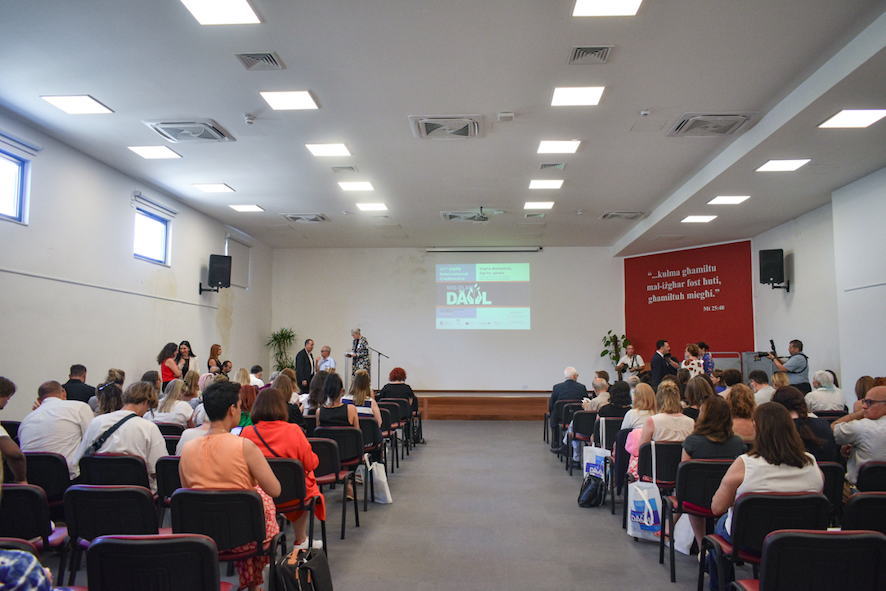
Held at Caritas Community Centre, Malta, this conference centred on understanding and dismantling the stigma faced by children affected by parental imprisonment, exploring how it permeates communities, institutions and systems. The conference brought together individuals with lived experience of parental imprisonment, NGOs, child-rights professionals, academics and high-level speakers, all in support of generating rights-based change to help destigmatise parental imprisonment for children.
Voices of lived experience driving change
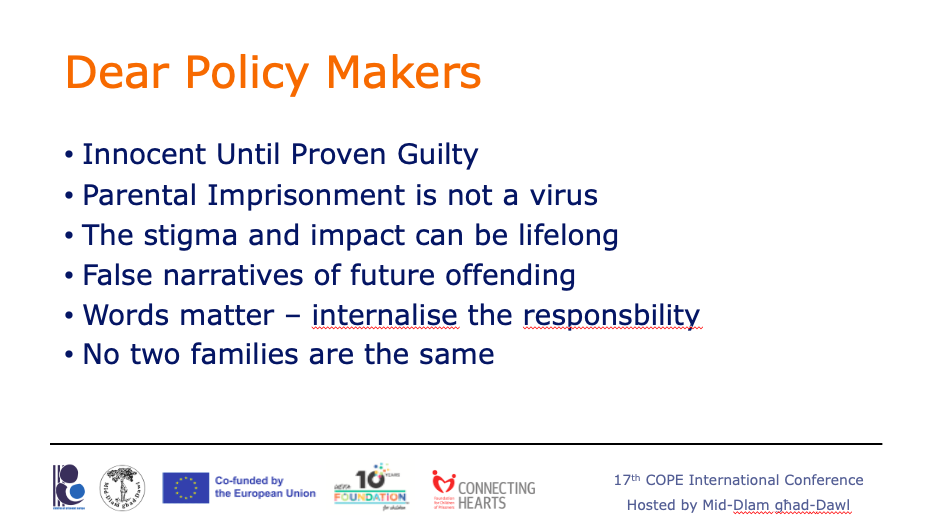
A crucial element of the conference was the active participation of young people with lived experience of parental imprisonment. Tasha, Evie and Jemmar from the Parental Imprisonment Collective (PIC) in the UK clearly articulated the changes they want to see. They highlighted the need for a fundamental attitude shift among key stakeholders.
Targeting services at children with parents in prison based on perceptions of them being ‘at risk’ of future criminal behaviour:
→ has unintended negative consequences for children
→ makes children feel labelled
(Kincaid, Roberts & Kane, 2019)
“Parental imprisonment is not a virus.”
— Tasha, Evie & Jemmar, Parental Imprisonment Collective
Source: Parental Imprisonment Collective, powered by Firebird Foundation.
Tasha, Evie and Jemmar also highlighted the lifelong nature of stigma associated with parental imprisonment. PIC advocates for person-centred, wrap-around support addressing health, education, financial and social challenges, emphasising that courts must consider children’s needs during sentencing. Their recommendations include consistent national processes, stigma-free language and enhanced cross-sector collaboration to uphold children’s rights and dignity well beyond childhood.
As Mireille Farrugia highlighted in her contribution:
“You cannot speak about children of prisoners without them being in the room…People can tell stories if they see them from the outside — my friends and family can tell you what I’ve been through but it will never be the same way [as how] I say it because they have not felt how the system feels. You can see a system and how it works, but you have to feel for you to understand how it is working, you know, on individuals, on human beings.”
The ideas for change and calls for action from those who have experienced parental imprisonment are indispensable to any discussion on this issue; their insights ground discussions in reality and ensure that solutions truly address children’s needs.
Championing children’s rights at the EU level
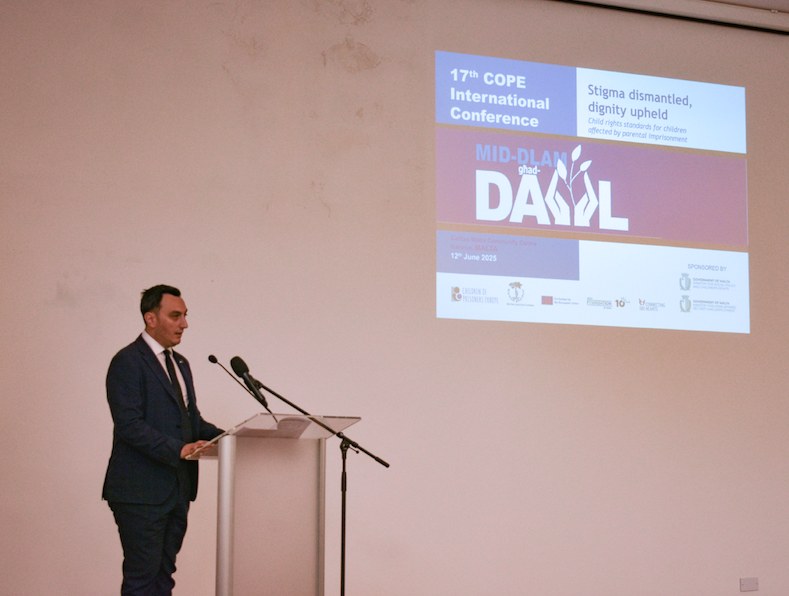
Glenn Micallef, EU Commissioner for Intergenerational Fairness, Youth, Culture and Sport, underscored COPE’s influential role in ensuring the EU Strategy on the Rights of the Child accounts for the needs of children whose parents have come in contact with the justice system. His presence at the conference marked a significant step in bridging grassroots practice with EU level policymaking. It reflected the growing recognition at European level of the need to prioritise the rights of children affected by parental imprisonment.
EU Commissioner Micallef praised COPE’s child-centred approach that brings visibility to the often-overlooked challenges faced by children with imprisoned parents. He emphasised how COPE’s evidence-based advocacy advances policy reforms across the EU, spotlighting the harmful effects of stigma on children’s mental health and well-being. As well as promoting and monitoring the implementation of the EU Strategy on the Rights of the Child, Commissioner Micallef noted that the EU is working on an action plan against cyberbullying. Stigma associated with parental imprisonment can circulate in the digital sphere too — this must be accounted for at the EU policy level. He reaffirmed that real change is possible when children’s dignity is respected and their voices empowered through platforms designed for meaningful participation.
A call for systemic reform
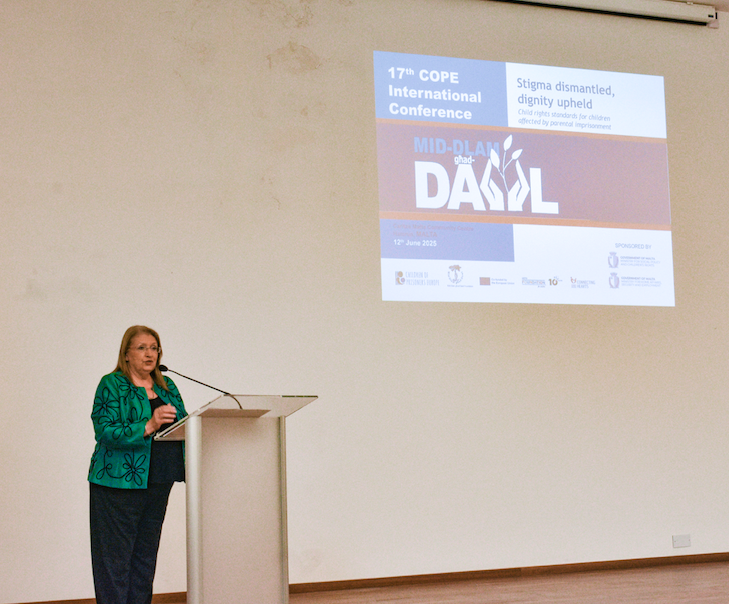
H.E. Marie-Louise Coleiro Preca, Former President of Malta and current Chair of the Foundation for the Wellbeing of Society, Malta, delivered a powerful appeal for urgent systemic reform. She praised the COPE network and the international movement for turning compassion into action and called for the proper establishment of child-friendly justice systems: “children deserve justice systems which see them and serve them.” Her Excellency responded to the theme of this conference “as a call to courage—we are here to disrupt injustice”, she noted.She stressed that supporting children with imprisoned parents is an act of responsibility and called for unified action to eliminate stigma through trauma-informed care, stigma-free education and justice systems grounded firmly in children’s rights and dignity. She cited the powerful words of French child psychoanalyst Françoise Dolto and highlighted that parents must be given opportunities to display their affection for the child: “Words humanise experience; what is traumatic for a child’s future is what goes unsaid.“
“Children should not inherit a sentence, they should inherit hope.”
— H.E. Marie-Louise Coleiro Preca
Evaluating stigma-reducing interventions
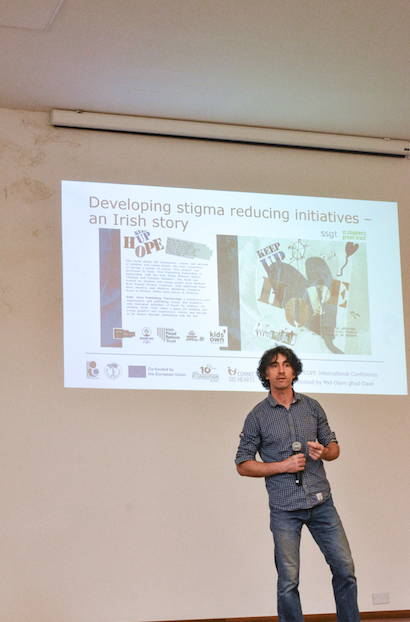
Fiona Donson, Aisling Parkes and Daragh Bradshaw shared insights from a process evaluation of a stigma-reducing project for children affected by parental imprisonment in Ireland, from University College Cork (Ireland). Their research highlights the importance of empowering children to express their experiences creatively through art and storytelling. This approach helped children connect with peers, raise awareness and challenge stigma. The team emphasised that reducing stigma leads to improved service provision—drawing a comparison to the topic of divorce. As divorce became generally more accepted and less stigmatised in Ireland over time, services to support children whose parents were going through a divorce increased and were improved. With respect to parental imprisonment, the associated stigma is still a hugely inhibiting factor in service provision for children. They noted that interventions must be child-centred, rights-based, inclusive and adaptable — recognising that no single approach fits all.
Access to child rights standards
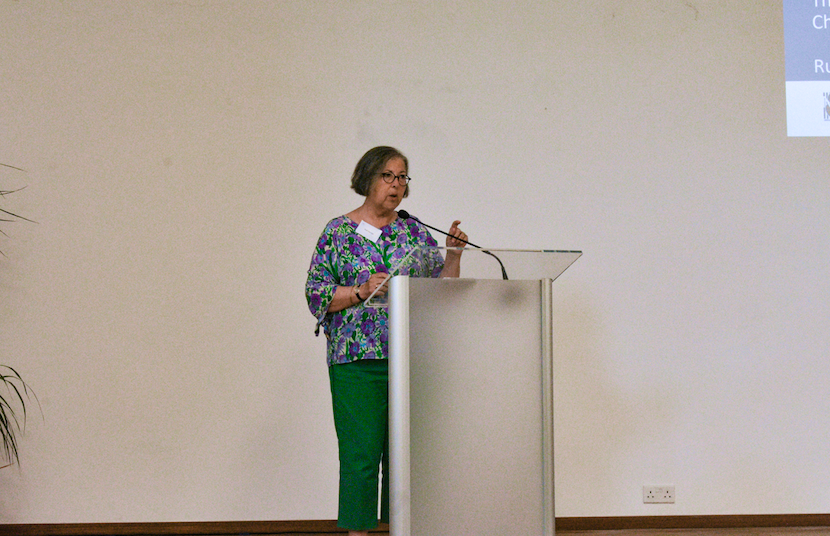
Ruth Farrugia from the University of Malta focused on the latter part of the conference title — “Child rights standards for children affected by parental imprisonment” — querying how children can access these standards.She highlighted the lack of systematic data collection across the EU on children of imprisoned parents and presented examples of where these child rights standards can be found (the Council of Europe Recommendation CM/Rec (2018)5, the UNCRC, the EU Child Rights Guarantee, among others). Farrugia stressed the critical need for genuine child participation in decisions affecting them, warning against misusing the “best interests of the child” principle as a substitute for children’s direct engagement. She highlighted her own “healthy scepticism” of the best interests principle, which too often is cited as “a short cut to bypass referral to the child”. She also outlined structural and psychological barriers children face in accessing justice and the pivotal role of independent child rights institutions and NGOs in ensuring children can actually access and exercise their rights.
Supporting Roma families through community engagement
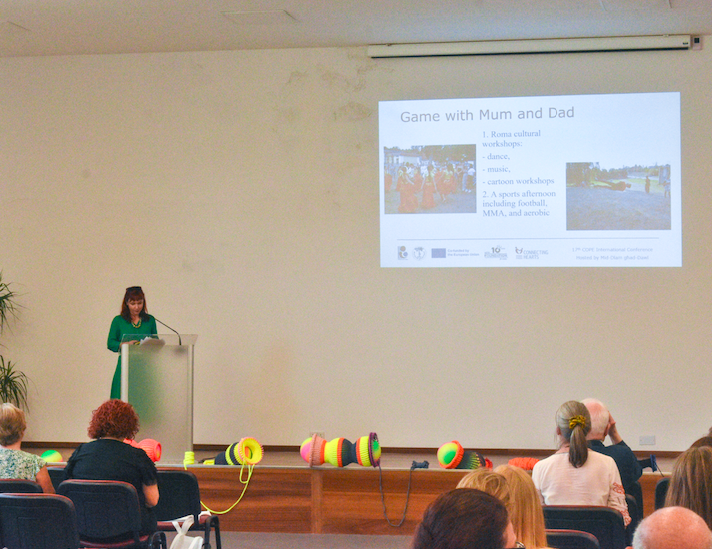
Šárka Vlková from Romodrom (Czechia) presented innovative support projects addressing stigma within Roma communities affected by imprisonment. These initiatives focus on strengthening family bonds and community involvement through prison social work, post-release support and family-centred programmes, such as the COPE-led project “Game with Mum & Dad.” Aligned with this project, Romodrom hosted an event in Czechia co-designed with children to offer sports and cultural activities fostering pride and connection and celebrating Roma culture. Thanks to COPE support, the project reached over 150 children affected by parental imprisonment and 280 caregivers and imprisoned parents in Czechia, providing a vital space for Roma families impacted by imprisonment and promoting child safeguarding and community empowerment. The prison service was closely involved in this project, which went a long way to dismantling preconceived notions of Roma communities and hopefully has laid the groundwork for a similar, in-prison event.
The ASPIRE Project: towards a national model in Wales
Nancy Loucks from Families Outside (UK) presented the ASPIRE project, commissioned by the Welsh Government to explore a national approach to improve wellbeing and educational outcomes for children with a parent in prison. The project identified a disconnect between prison-focused family contact policies and child-centred policies addressing children’s rights and needs. Despite effective local initiatives such as the HMP Parc School Zone Model—which demystifies prison for teachers and fosters family engagement—support remains fragmented. ASPIRE advocates for shifting from a justice-led to a child-led approach, fostering collaboration among justice, health, education, social work and families to better meet children’s needs.

Art as a language of inclusion
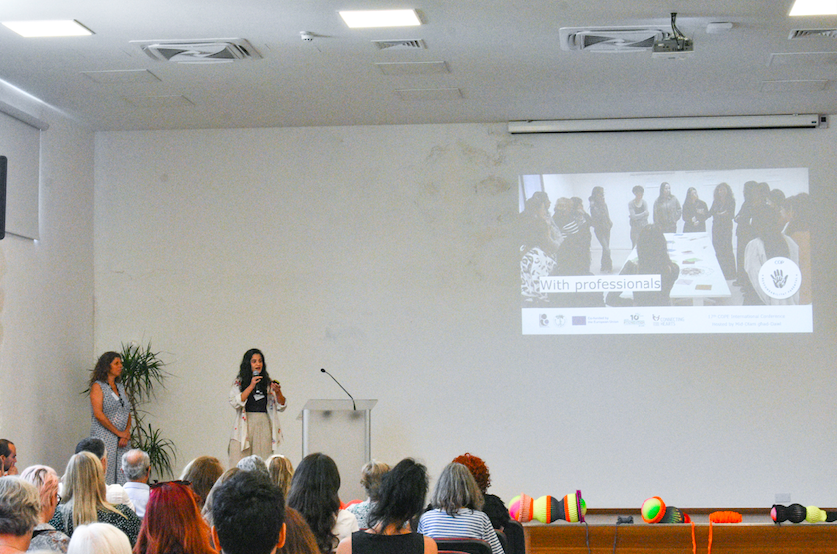
Belén Masola and Helena Cabo Vila from Projecte Nius (Spain) exemplified the power of art as a universal language that can foster dignity, connection and social inclusion for families affected by imprisonment. Their creative projects within prisons invite professionals to embrace more innovative and empathetic approaches, enhancing engagement with families and promoting inclusion.
One such initiative is the ‘Meraki Project’, which aims to strengthen and support Parental Responsibility Management Groups in all prisons in Catalonia. By creating inclusive meeting spaces for mothers, fathers, families,and professionals, the Meraki Project uses artistic and pedagogical tools to promote more responsible parenting. One of these tools is weaving, and during the conference, they showcased creations made by imprisoned mothers while also inviting participants to take part in the process.
The COPE conference further underscored how invisible walls may be harder to dismantle than physical ones, but creating a culture shift is essential. The COPE Network remains committed to breaking stigma and advancing children’s rights through collaboration, advocacy and child-centred approaches. Building on the progress made so far, COPE will continue to engage those with lived experience, influence policy and support innovative interventions across Europe.
As COPE President Kate Philbrick said in her closing remarks:
“I value the courage of all participants in looking at stigma and how to dismantle it. Stigma remains ubiquitous, and children impacted by parental imprisonment struggle to experience dignity and may barely cope. We need to shift the culture towards intergenerational fairness and create spaces where, with creativity and sensitivity, children’s stories can be heard, so that children and the adults they become can move beyond coping to thriving and living with hope.”
In addition to the International Conference, COPE members and affiliates gathered in Malta for the COPE 2025 General Assembly, a Forum for Reflection and Exchange and a Networking session, providing vital opportunities for members across countries to reflect on progress, share innovative initiatives, discuss challenges and explore solutions, all while strengthening partnerships within the network.
The Forum for Reflection and Exchange, also revolving around the theme of stigma, featured a striking photo exhibition by Sina Opalka. The exhibition documented not only her own experience of growing up with a parent in prison, but also the experience of many different individuals impacted by imprisonment, whether direct experience, through the imprisonment of a loved one, or within the framework of restorative justice. The unifying message is the need to humanise situations and to recognise the various challenges that children can experience when a parent goes to prison. As she eloquently highlighted in opening the Conference:
Too many children are thrown into living conditions that stretch their resilience far beyond its limits.
Every child deserves to be protected, to be heard, and to be seen. We often underestimate the importance of this simple truth, and overestimate how difficult it is to make it happen.
It doesn’t always take much. What it takes is validation of their valuable perception of the world around them. Listen to them — they have so much to say. We owe it to the children of incarcerated parents to see them as new beginnings, not as a broken continuation of something that is doomed to fail.